What Is a Credit Score and How Does It Actually Work?
A credit score is one of those numbers that can quietly affect some of the biggest financial decisions in your life.
It may influence whether you qualify for a credit card, car loan, or mortgage—and it can also affect the interest rate and credit limit a lender offers you.
But what exactly is a credit score? Where does the number come from? And why can your score change even when you feel like you haven’t done anything wrong?
The simple answer is this:
A credit score is a numerical estimate of how likely you are to repay borrowed money as agreed.
Most commonly used credit scores fall between 300 and 850, with higher scores generally signaling lower credit risk to lenders.
Your score isn’t randomly assigned, and it isn’t based on how much money you earn. Instead, credit-scoring models analyze information contained in your credit reports—such as whether you pay your accounts on time, how much debt you carry, how long you’ve used credit, and how often you’ve recently applied for new credit.
Understanding how this system works is one of the first steps toward building—or rebuilding—stronger credit.
What Is a Credit Score?
A credit score is a number created by a mathematical scoring model using information from your credit history.
Think of it as a risk indicator for lenders.
When you apply for credit, the lender wants to answer a basic question:
How likely is this person to repay the money according to the agreement?
Rather than manually analyzing every detail of millions of borrowers’ credit histories from scratch, lenders can use credit scores as one part of their decision-making process.
A higher score generally indicates that your credit history suggests a lower risk of missed payments.
A lower score suggests greater risk.
However, your credit score is not the only thing lenders consider. Depending on the product, lenders may also evaluate factors such as your income, existing debts, assets, employment circumstances, and their own underwriting requirements. FICO itself notes that income is not part of the FICO Score calculation, although lenders may consider it separately.
Credit Score vs. Credit Report: They’re Not the Same Thing
This distinction is extremely important.
Your credit report and your credit score are related, but they are not the same thing.
Your credit report is the underlying record.
It contains information about your credit activity and current credit situation, including things such as:
- credit cards;
- loans;
- payment history;
- account balances;
- credit limits;
- collection accounts;
- certain public-record information;
- inquiries from companies that accessed your credit file.
The Consumer Financial Protection Bureau describes a credit report as a statement containing information about your credit activity and current credit situation.
Your credit score is calculated from that information.
A scoring model analyzes information in the report and produces a number.
An easy way to remember the difference is:
Credit report = the information
Credit score = a calculation based on that information
So if information on your credit report changes, your credit score may change as well.
Who Creates Your Credit Reports?
In the United States, the three major nationwide credit reporting companies are:
- Equifax
- Experian
- TransUnion
Creditors such as banks, credit card issuers, auto lenders, and other companies may report account information to one or more of these credit bureaus.
That creates another important point:
Your three credit reports may not always contain exactly the same information.
One lender might report to all three bureaus, while another may report differently.
That can contribute to differences between your credit scores.
Who Calculates Your Credit Score?
The credit bureaus do not represent a single universal scoring system.
Different scoring models can analyze credit-report information differently.
Two major names consumers frequently encounter are:
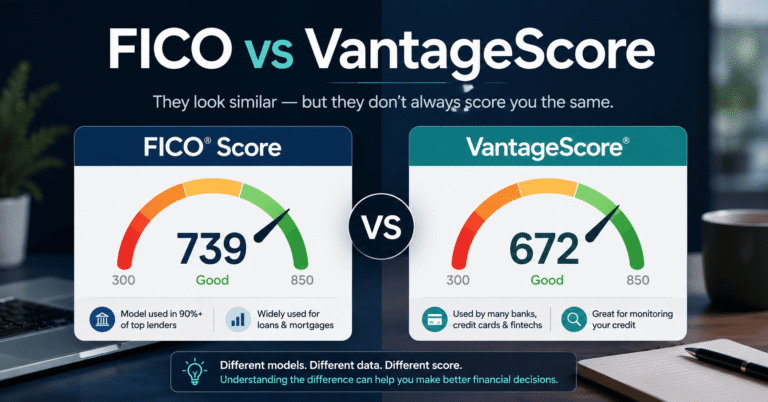
FICO
FICO Scores are widely used in lending decisions.
VantageScore
VantageScore is another credit-scoring system developed by the three major credit bureaus.
And even within FICO, there isn’t just one score.
There are different FICO versions and industry-specific scores.
This means the idea that every person has one official credit score is incorrect.
The CFPB specifically explains that consumers can have multiple credit scores because different lenders use different scoring formulas, products may use different score types, information can come from different credit-reporting companies, and the score can be calculated at different times.
Why Is My Credit Score Different on Different Apps?
This surprises many people.
Imagine that your banking app shows:
712
Another service shows:
698
Then a car lender tells you that your score is:
705
Does that mean somebody made a mistake?
Not necessarily.
There are several possible reasons.
1. Different scoring models
One service may show a VantageScore while a lender uses a FICO Score.
2. Different versions of the same model
There are multiple versions of FICO Scores.
3. Different credit bureaus
One score might be based on your Experian report and another on your TransUnion report.
4. Different dates
Credit information changes over time.
A credit card company might report a new balance after one score was calculated but before another was calculated.
5. Different types of lending
Lenders can use scores designed for particular types of credit.
For example, the score a mortgage lender reviews does not necessarily have to match the score displayed by your credit card app.
The important lesson is:
Don’t panic simply because two legitimate credit scores are a few points apart.
Instead, focus on the underlying credit behavior that influences your overall credit profile.
What Is a Good Credit Score?
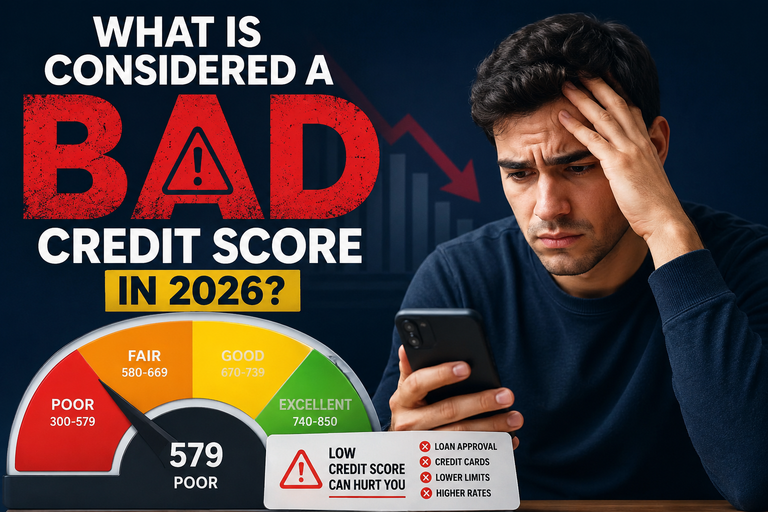
For base FICO Scores, the commonly used range is 300 to 850.
FICO generally categorizes scores as follows:
| FICO Score | General Rating |
|---|---|
| 300–579 | Poor |
| 580–669 | Fair |
| 670–739 | Good |
| 740–799 | Very Good |
| 800–850 | Exceptional |
These ranges are useful benchmarks, but they are not universal approval rules.
Having a 700 score does not guarantee approval.
Having a 650 score does not guarantee rejection.
Each lender can establish its own requirements and may consider information beyond your credit score.
The practical goal should therefore not be:
“How do I get the perfect credit score?”
A better question is:
“How can I build a strong, consistent credit profile that makes me a lower-risk borrower?”
How Is a FICO Credit Score Calculated?
FICO groups the information used in its traditional scoring methodology into five major categories.
For the general population, the approximate weighting is:
| Factor | Approximate Weight |
| Payment history | 35% |
| Amounts owed | 30% |
| Length of credit history | 15% |
| New credit | 10% |
| Credit mix | 10% |
FICO explains that these percentages reflect the importance of the five categories for the general population; the precise impact of individual information can vary depending on someone’s overall credit profile.
Let’s look at what each category actually means.
1. Payment History — About 35%
Payment history is generally the largest category in a FICO Score.
The scoring model wants to know:
Have you paid your credit obligations as agreed?
Information considered can include whether accounts were paid on time and whether there have been:
- late payments;
- missed payments;
- collections;
- charge-offs;
- bankruptcies;
- other serious delinquencies.
FICO identifies payment history as approximately 35% of a FICO Score.
This is why consistently making payments on time is so important.
Example
Suppose Maria has had three credit cards for several years and has never missed a payment.
David has similar accounts, but recently became 60 days late on one of his cards.
All other things being equal, David’s recent late payment may make him appear riskier to a scoring model.
That doesn’t mean his credit can never recover.
It means payment history matters—and future positive behavior matters too.
2. Amounts Owed — About 30%
This category considers how much debt you’re carrying.
For credit cards, one particularly important concept is credit utilization.
Credit utilization compares the amount of revolving credit you’re using with your available credit limits.
Example
Suppose you have one credit card with:
Credit limit: $5,000
Reported balance: $4,000
Your utilization on that card is:
80%
Now imagine your balance is only $500.
Your utilization would be:
10%
Those two situations can present very different levels of credit risk even though the credit limit is exactly the same.
FICO says amounts owed account for about 30% of its traditional score calculation, and credit utilization is one of the elements considered within that category.
This does not mean that having debt automatically gives you bad credit.
The scoring model looks at debt in context.
3. Length of Credit History — About 15%
Credit scoring models also consider how long you’ve been managing credit.
Factors can include:
- age of your oldest account;
- age of your newest account;
- average age of your accounts;
- how long particular accounts have existed.
FICO assigns approximately 15% of its traditional score calculation to length of credit history.
This helps explain why someone who has responsibly used credit for ten years may have an advantage over someone who opened their first credit card three months ago.
It also explains why building excellent credit usually takes time.
You can’t make a three-month credit history become ten years old overnight.
4. New Credit — About 10%
When you apply for certain types of new credit, a lender may obtain your credit report.
This can create a hard inquiry.
Hard inquiries may affect a FICO Score, although the impact of a single inquiry is generally small and varies according to the person’s overall credit profile. FICO says that for most people, one additional inquiry reduces a FICO Score by fewer than five points.
Opening several accounts within a short period can potentially signal greater risk than applying selectively.
This doesn’t mean you should be afraid to apply for credit.
It means you should apply intentionally rather than opening accounts just because they’re available.
5. Credit Mix — About 10%
Credit mix refers to your experience managing different types of credit.
Credit accounts generally fall into categories such as:
Revolving credit
Examples:
- credit cards;
- certain lines of credit.
Installment loans
Examples:
- auto loans;
- student loans;
- personal loans;
- mortgages.
Having experience with different account types may help demonstrate that you can manage different forms of debt responsibly.
But don’t misunderstand this category.
You should not take out unnecessary debt simply to improve your credit mix.
FICO itself advises against opening new accounts solely to increase credit mix.
What Is Credit Utilization?
Because utilization is so important for people trying to rebuild credit, it’s worth understanding separately.
The basic formula is:
Credit utilization = reported credit card balance ÷ credit limit × 100
For example:
You have a card with a $2,000 limit.
Your reported balance is $600.
$600 ÷ $2,000 = 0.30
Your utilization is:
30%
If the reported balance falls to $200:
$200 ÷ $2,000 = 0.10
Your utilization becomes:
10%
Scoring models can look at how much revolving credit you’re using relative to the amount available to you.
Generally, lower utilization tends to be more favorable than being close to maxing out your cards.
We’ll cover exactly how utilization works—and why the popular “30% rule” is often misunderstood—in a separate guide.
Does Your Income Affect Your Credit Score?
Not directly in a FICO Score.
Your salary is not one of the five FICO scoring categories.
A person earning $200,000 per year can have poor credit.
A person earning $45,000 can have excellent credit.
Why?
Because a credit score primarily evaluates how you’ve managed credit, not how wealthy you are.
However, lenders may consider income separately when deciding whether you can afford a new loan or credit obligation.
Creditworthiness and income are related to lending decisions, but they aren’t the same measurement.
Does Checking Your Own Credit Score Hurt It?
No.
Checking your own credit report or score is generally considered a soft inquiry and does not hurt your FICO Score.
A hard inquiry is different.
It can occur when you actively apply for a product such as:
- a credit card;
- an auto loan;
- a mortgage;
- another type of financing.
FICO confirms that checking your own credit report or score does not lower your FICO Score.
So monitoring your own credit is not something you need to avoid.
Why Does a Credit Score Change?
Your credit score is not permanent.
It can rise or fall as information in your credit reports changes.
For example, your score could change after:
- a credit card reports a higher balance;
- you significantly pay down a balance;
- a new account appears;
- a late payment is reported;
- an account gets older;
- a hard inquiry occurs;
- inaccurate information is corrected;
- a negative item ages or is eventually removed according to applicable reporting rules.
This is also why checking your score on Monday and again several weeks later can produce different numbers.
Your credit profile is constantly evolving.
How Often Does Your Credit Score Update?
There isn’t one universal “credit score update day.”
Your score can be recalculated whenever it is requested using the information available in the relevant credit report at that time.
What matters is when creditors update information with the credit bureaus.
For example, you could pay a credit card balance today, but that doesn’t necessarily mean your credit report will show the new balance tomorrow.
The creditor generally has to report the updated account information first.
Only then can a scoring model use the new information.
This is why paying down a credit card does not necessarily cause an instant credit-score change.
What Information Is Not Part of a FICO Credit Score?
A FICO Score is calculated from information in your credit report.
It does not directly calculate your score based on factors such as your salary.
And your credit score should not be confused with a complete assessment of your financial health.
For example, two people could have the same credit score while having very different:
- incomes;
- savings balances;
- household expenses;
- net worth;
- emergency funds.
A strong credit score is useful.
But it is only one part of your overall financial picture.
Why Does Your Credit Score Matter?
Your credit score can influence important financial opportunities.
Companies may use credit scores when deciding:
- whether to approve a credit card;
- whether to approve an auto loan;
- whether to offer a mortgage;
- what interest rate to offer;
- what credit limit to provide.
The CFPB notes that credit scores can affect both access to credit products and the rate a consumer receives.
Consider two borrowers purchasing the same car.
One borrower qualifies for a lower interest rate.
The other receives a significantly higher rate.
Even if they borrow the same amount, the second borrower could pay thousands of dollars more over the life of the loan.
That’s why improving your credit isn’t merely about increasing a number on an app.
It can potentially reduce the cost of borrowing money.
Can You Improve a Bad Credit Score?
Yes.
But legitimate credit improvement is usually a process rather than an overnight trick.
The fundamentals are surprisingly straightforward:
Pay your accounts on time.
Payment history is a major scoring factor.
Reduce revolving balances.
Lower credit card balances can improve your utilization profile.
Avoid unnecessary applications.
Don’t repeatedly apply for credit without a reason.
Review your credit reports.
Incorrect information should be identified and disputed through the proper process.
Give positive history time to develop.
Older, well-managed accounts can contribute to a stronger credit profile.
The CFPB states that there is no secret formula for building a strong credit score and emphasizes paying loans on time and avoiding getting too close to credit limits.
What If Your Credit Score Is Already Low?
A low score isn’t a permanent label.
Instead of focusing only on today’s number, determine why the score is low.
For example:
If your problem is late payments
Your priority may be getting accounts current and establishing consistent on-time payments.
If your problem is high utilization
Your strategy may center on reducing credit card balances.
If your credit file contains errors
Your priority may be reviewing your reports and disputing inaccurate information.
If you have very little credit history
The problem may not be bad credit at all—you may simply have a thin credit file.
If you’ve experienced collections or charge-offs
You’ll need a strategy that considers the specific negative items on your reports.
Credit rebuilding works best when the solution matches the actual problem.
A Simple Example of How Credit Scores Work
Imagine two consumers: Alex and Jordan.
Both earn $60,000 per year.
Alex
- has three credit cards;
- has never missed a payment;
- uses relatively little of the available limits;
- has several years of credit history;
- applies for new credit occasionally.
Jordan
- also has three credit cards;
- recently missed two payments;
- has cards close to their limits;
- opened several new accounts recently.
Their incomes are identical.
But their credit scores could be significantly different because the scores evaluate their credit histories and credit-management patterns, rather than simply comparing salaries.
This is the core idea behind credit scoring:
What you’ve done with credit matters more to the score than how much money you make.
Five Things to Remember About Credit Scores
If you’re new to credit, remember these five principles:
- You don’t have just one credit score. Different models and credit reports can produce different numbers.
- Your credit report and credit score are different. The report contains the information; the score analyzes that information.
- Payment history matters heavily. Paying on time consistently is one of the most important habits you can build.
- Credit card balances matter. High utilization can affect your credit profile even if you aren’t late.
- Credit improvement usually takes time. Strong credit is built through consistent behavior rather than shortcuts.
Frequently Asked Questions
What is a credit score in simple terms?
A credit score is a number designed to estimate how likely you are to repay borrowed money according to the terms of your agreement.
What is the highest credit score?
For commonly used base FICO Scores, the highest possible score is 850. The standard range is generally 300–850.
Is 700 a good credit score?
Under FICO’s general ranges, a score between 670 and 739 is considered “Good,” so a 700 FICO Score falls within that category.
Individual lenders can still use their own approval standards.
Does having a lot of money give you a high credit score?
No.
Income itself is not part of the FICO Score calculation.
How you manage the credit accounts appearing on your credit reports is what matters to the score.
Does checking my own credit lower my score?
No. Checking your own credit is a soft inquiry and does not lower your FICO Score.
Why are my credit scores different?
You can have different scores because different companies may use different:
- credit bureaus;
- scoring models;
- model versions;
- calculation dates;
- lending-specific scores.
Small differences between legitimate scores are normal.
How fast can a credit score improve?
There is no universal timeline.
Some changes, such as reducing high revolving balances, may affect your profile after updated information is reported. Other improvements—particularly recovering from serious negative history—can require considerably more time.
The best approach is to focus on the factors you can control rather than trying to force a specific number by a specific date.
The Bottom Line
A credit score isn’t a judgment about whether you’re good or bad with money.
It’s a risk-prediction tool based primarily on information in your credit reports.
The most important factors generally involve how reliably you’ve paid credit obligations, how much debt you’re using, how long you’ve managed credit, your recent applications for credit, and your experience with different types of accounts.
Once you understand that, credit scores become much less mysterious.
You don’t need tricks.
You need to understand what’s affecting your particular credit profile and improve those areas systematically.
If your score isn’t where you want it to be today, the next question isn’t:
“How do I magically raise my score?”
It’s:
“What is currently holding my credit back, and what should I work on first?”
That’s where rebuilding credit really begins.
Editorial Sources
This guide was prepared using consumer-credit information from the Consumer Financial Protection Bureau (CFPB), Federal Trade Commission (FTC), and FICO. Credit-scoring formulas and lender requirements can vary, so individual results are not guaranteed.
Educational disclaimer: This article is for general educational purposes and does not constitute individualized financial, legal, or credit advice.