What Is Considered a Bad Credit Score in 2026?
A bad credit score can make borrowing more expensive and may reduce the number of credit products available to you. But there is no single number that every lender considers “bad.”
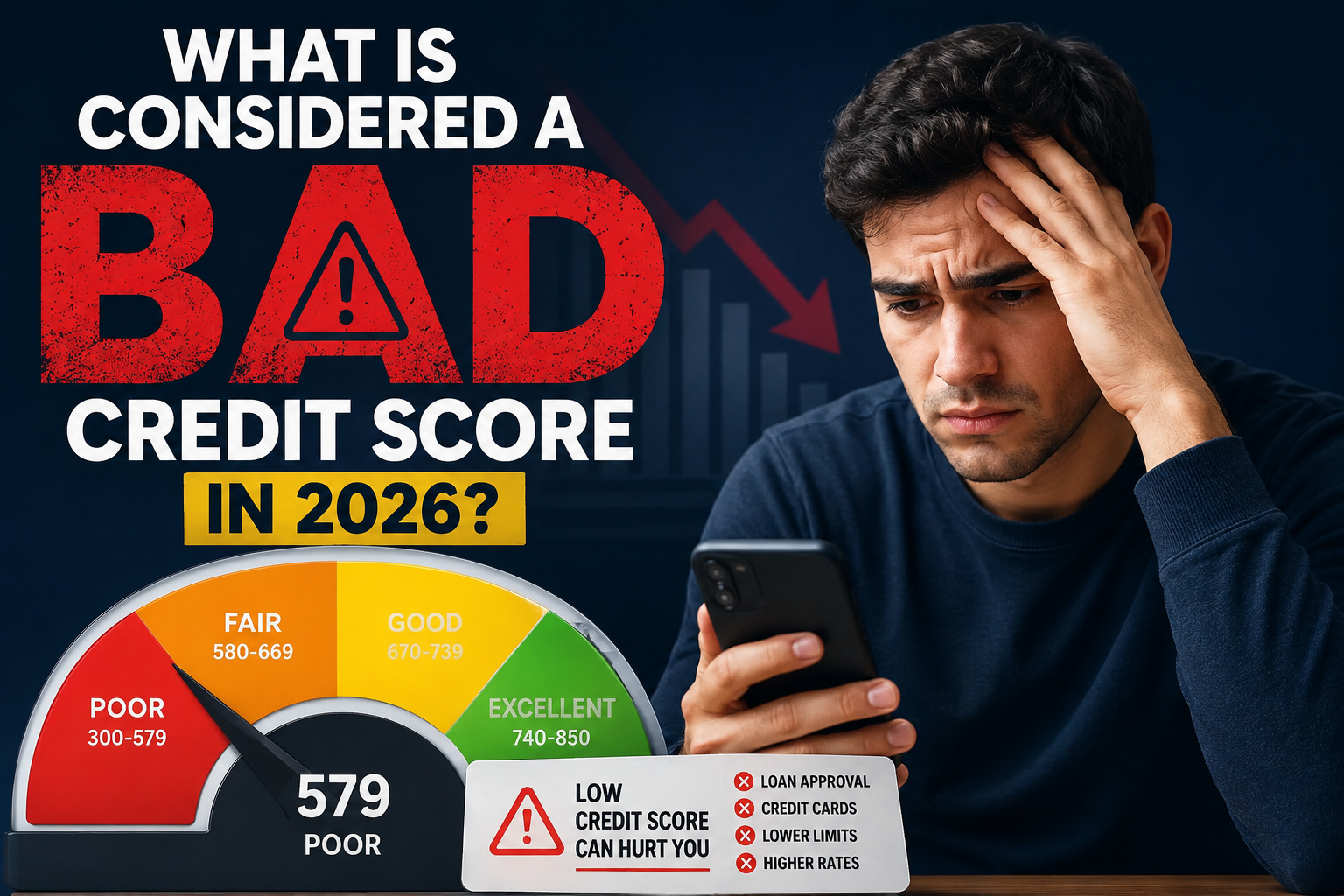
If you are looking at a typical FICO Score, a score below 580 is officially classified as Poor. Scores between 580 and 669 are considered Fair, which means they are not technically in FICO’s Poor category but may still make it harder to qualify for favorable rates and terms.
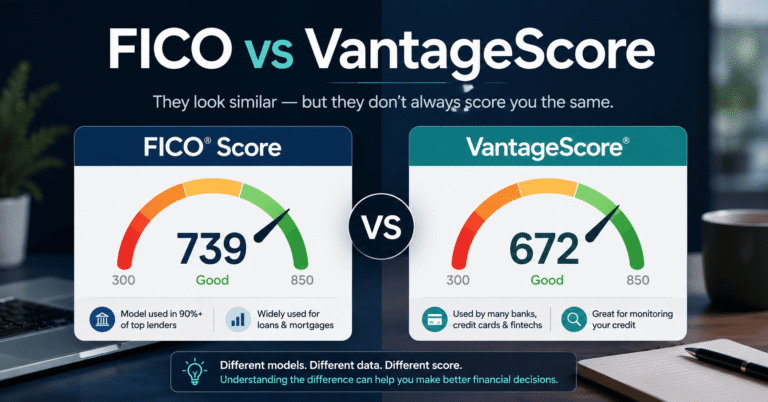
VantageScore uses different categories. Under VantageScore 4.0, scores from 300 to 600 are Subprime, while scores from 601 to 660 are Near Prime.
That difference is important because the credit score you see in an app may not be the same scoring model a lender uses.
Quick Answer
For most consumers, this is the simplest way to think about a bad credit score in 2026:
| Credit Score | General Interpretation |
|---|---|
| 300–579 | Poor under FICO |
| 580–600 | Fair under FICO, but Subprime under VantageScore |
| 601–660 | Fair under FICO and Near Prime under VantageScore |
| 661–669 | Fair under FICO and Prime under VantageScore |
| 670+ | Good or better under FICO |
The important point is that “bad credit” is not a universal technical category. Different scoring models and lenders may interpret the same number differently. The CFPB explains that consumers can have multiple credit scores because scores may vary based on the scoring model, credit bureau, type of loan, data being used, and even the date the score was calculated.
What Is a Bad FICO Score?
Most standard FICO Scores range from 300 to 850.
FICO currently divides that range into five categories:
| FICO Score | FICO Rating |
|---|---|
| Below 580 | Poor |
| 580–669 | Fair |
| 670–739 | Good |
| 740–799 | Very Good |
| 800+ | Exceptional |
Therefore, if someone asks:
“What is considered a bad FICO score?”
The clearest answer is:
A FICO Score below 580 falls into FICO’s Poor range.
However, that does not mean that a score of 580, 600, or 650 automatically gives you access to attractive lending terms. Those scores remain in FICO’s Fair category, and lenders make their own approval and pricing decisions.
FICO itself notes that many lenders may approve consumers with Fair scores, but those scores remain below the average range of U.S. consumers.
What Is a Bad VantageScore?
VantageScore also typically uses a scale from 300 to 850, but its classifications are different from FICO’s.
VantageScore 4.0 currently uses the following credit tiers:
| VantageScore | Credit Tier |
|---|---|
| 300–600 | Subprime |
| 601–660 | Near Prime |
| 661–780 | Prime |
| 781–850 | Superprime |
That creates some situations that can be confusing.
For example, a 600 credit score is considered:
- Fair according to FICO.
- Subprime according to VantageScore.
Neither score is necessarily wrong. They are simply different scoring systems.
If you haven’t already, read our guide FICO vs. VantageScore: What’s the Difference? to understand why the score you see may differ from the one a lender sees.
Is a 500 Credit Score Bad?
Yes.
A 500 FICO Score falls well inside FICO’s Poor range, because any FICO Score below 580 is classified as Poor.
A 500 VantageScore also falls within the Subprime category.
That does not mean you are permanently stuck at 500 or that no lender will ever approve you. It means your credit profile currently represents a higher level of risk under these scoring models.
What matters next is identifying why the score is low.
Possible factors can include:
- Late or missed payments
- High revolving balances
- Collection accounts
- Charge-offs
- Recent applications for credit
- A short or limited credit history
- A combination of several factors
Your next step should not simply be “get the score higher.” It should be to determine what information in your credit reports is contributing to the score.
Our next guide, Is a 500 Credit Score Really Bad? What You Can Do Next, will go deeper into that situation.
Is a 550 Credit Score Bad?
A 550 FICO Score is classified as Poor.
It is also within VantageScore’s Subprime range.
At 550, improving your credit usually requires more than simply applying for another credit card.
The appropriate strategy depends on what is actually appearing on your reports.
Someone with a 550 score caused primarily by high credit card balances may need a different strategy from someone whose report contains multiple recent late payments, collections, or charge-offs.
This is one reason generic promises such as “gain 100 credit score points in 30 days” should be treated cautiously.
There is no fixed number of points that a specific action will add to every person’s score.
Is a 600 Credit Score Bad?
This is where the answer becomes more nuanced.
A 600 FICO Score is Fair, not Poor. However, a 600 VantageScore is still classified as Subprime.
So someone saying “600 is a bad score” may be oversimplifying the situation.
A score of 600 is better than 500, but it is still below FICO’s Good range, which begins at 670.
With a 600 score, approval may still be possible for some products, but a higher score can generally improve access to credit and potentially result in better interest rates or terms. The CFPB notes that higher scores generally make qualification easier and may lead to lower interest rates.
Is a 620 Credit Score Bad?
A 620 FICO Score is Fair.
Under VantageScore, 620 falls within the Near Prime range.
That means 620 is not considered Poor under FICO, but it also does not fall into FICO’s Good category.
This distinction matters because consumers sometimes treat credit scores as if there were one magical cutoff:
Below this number, everyone gets denied. Above it, everyone gets approved.
Credit decisions do not work that way.
A lender may consider the credit score alongside other underwriting information and may also use a particular version of a scoring model.
The CFPB emphasizes that there are many different credit scores rather than one universal score.
Is a 650 Credit Score Bad?
A 650 FICO Score is still in the Fair range, although it is getting relatively close to FICO’s Good range, which begins at 670.
Under VantageScore, 650 is categorized as Near Prime.
So calling 650 simply “bad” leaves out important context.
A consumer at 650 may have substantially different credit options from someone at 500, even though neither has reached FICO’s Good category.
If your score is already around 650, it is especially important to avoid making unnecessary moves solely because you are trying to reach 670 quickly.
Focus on the underlying credit profile rather than obsessing over a single number.
Is 670 a Good Credit Score?
Under FICO’s standard ranges, 670 is the beginning of the Good category.
Under VantageScore, 670 is within its Prime range.
But crossing from 669 to 670 does not suddenly guarantee approval for every credit card, auto loan, or mortgage.
Credit score ranges are useful benchmarks—not guarantees.
The individual lender still determines its approval standards and may use additional information when evaluating an application.
Why Can a “Bad” Credit Score Cost You More?
Credit scores are designed to help lenders estimate credit risk.
In general, a higher score may make it easier to qualify for a loan and may help you receive better interest rates or other loan terms.
A lower score may therefore lead to situations such as:
- Fewer available credit products
- Higher interest rates
- Lower credit limits
- Larger required deposits on certain products
- Less favorable loan terms
- Additional underwriting scrutiny
However, a low score does not guarantee denial, just as a high score does not guarantee approval.
Creditworthiness involves more than one number.
Why Is Your Credit Score Low?
A credit score is calculated using information contained in your credit report.
For FICO Scores, five broad categories influence the calculation:
| FICO Factor | General Weight |
|---|---|
| Payment history | 35% |
| Amounts owed | 30% |
| Length of credit history | 15% |
| New credit | 10% |
| Credit mix | 10% |
FICO explains that these percentages represent the general importance of the categories, although the exact effect can vary based on an individual’s credit profile.
Payment history and amounts owed are therefore particularly important areas to investigate when trying to understand a low FICO Score.
But do not assume you know the cause without first looking at your credit reports.
What Should You Do If You Have a Bad Credit Score?
If your score is lower than you want, start with the information behind the score.
1. Review All Three Credit Reports
Get your reports from Equifax, Experian, and TransUnion.
Consumers in the United States can currently obtain free online credit reports from each of the three nationwide credit bureaus every week through AnnualCreditReport.com. The FTC identifies it as the authorized website for obtaining the free reports provided under federal law.
Your reports may not be identical, so checking all three matters.
2. Look for Errors
Do not assume that every negative item is accurate.
Check information such as:
- Accounts you do not recognize
- Incorrect balances
- Payments incorrectly reported as late
- Duplicate accounts
- Accounts that do not belong to you
- Incorrect personal information
If information is genuinely inaccurate, you have the right to dispute it.
The CFPB recommends disputing inaccurate information with the credit reporting company and providing an explanation and supporting documentation.
Do not dispute accurate information simply because it is negative.
3. Protect Your Payment History
Payment history is the largest general category in a FICO Score, representing about 35% of the calculation.
That makes preventing additional late payments particularly important.
Consider tools such as:
- Automatic payments
- Calendar reminders
- Due-date alerts
- A dedicated bill-payment account
If you are already behind, contact the creditor and understand your available options rather than ignoring the account.
4. Review Credit Card Balances
Amounts owed represent another major FICO category.
High revolving balances can affect your credit profile, particularly in relation to the amount of available revolving credit you are using.
Reducing balances can therefore be useful, but there is no universal promise that paying a certain dollar amount will increase your score by a certain number of points.
5. Avoid Chasing Quick Fixes
A common mistake after discovering a bad credit score is applying for several new accounts at once.
New credit is one of the factors considered by FICO, and applications for credit can result in hard inquiries.
Do not open accounts simply because someone promises that doing so will immediately raise your score.
Choose financial products because they make sense for your situation—not because you are trying to manipulate a number overnight.
How Long Does It Take to Go From Bad Credit to Good Credit?
There is no universal timeline.
One person may see meaningful improvement relatively quickly after reducing high revolving balances. Another person may be dealing with recent late payments, collections, charge-offs, or other serious negative information that takes much longer to overcome.
Credit scores are based on your overall credit profile.
That is why claims such as:
- “Increase your score 100 points in 30 days”
- “Get a 700 score in two weeks”
- “Erase all negative information instantly”
should not be treated as guaranteed outcomes.
Consistent positive credit behavior usually matters more than finding a supposed shortcut.
For a more detailed explanation, read How Long Does It Take to Improve Your Credit Score?
A Bad Credit Score Is Not Permanent
A low credit score describes your current credit profile. It does not define your financial future.
Credit reports change as lenders report new information, balances change, accounts age, payments are made, and older information becomes less influential or eventually falls off your reports according to applicable reporting rules.
The most productive approach is therefore to focus on what you can control:
Check your reports → identify the problems → correct genuine errors → prevent new late payments → manage balances → build positive history over time.
You do not need a perfect credit score.
The objective is to build a stronger, more stable credit profile that gives you better financial options.
Frequently Asked Questions
What credit score is considered bad in 2026?
For standard FICO Scores, below 580 is classified as Poor. Scores from 580 to 669 are Fair. VantageScore uses different categories and classifies scores from 300 to 600 as Subprime.
Is 600 a bad credit score?
A 600 FICO Score is classified as Fair, not Poor. However, a 600 VantageScore falls within VantageScore’s Subprime category.
Is 650 a bad credit score?
A 650 FICO Score is Fair. It is below the Good FICO range, which begins at 670, but substantially above FICO’s Poor range.
What is the lowest possible credit score?
Most standard FICO and VantageScore models use a range beginning at 300 and ending at 850. Some specialized scoring models may use different ranges.
Can you get approved for credit with a bad credit score?
Possibly. A low score does not automatically mean every lender will deny you. Lenders have different underwriting criteria, and the score is only part of the overall lending decision.
Does checking your own credit hurt your score?
Checking your own credit report does not hurt your credit score. The CFPB specifically states that requesting your own credit report does not negatively affect your score.
Can you improve a bad credit score?
Yes, credit profiles can improve over time. The appropriate strategy depends on what is causing the low score. Start by reviewing your credit reports, correcting genuine errors, protecting payment history, and managing outstanding balances.
Bottom Line
So, what is considered a bad credit score in 2026?
For FICO, the clearest benchmark is below 580, which FICO classifies as Poor.
But the complete answer is more nuanced.
A 600 score may be Fair under FICO and Subprime under VantageScore. A 650 may still be Fair under FICO while being Near Prime under VantageScore. And lenders may establish their own standards for individual products.
Instead of focusing only on whether your score is labeled “bad,” identify what is affecting your credit profile and work systematically on the factors you can improve.
A credit score is a snapshot—not a permanent sentence.
Editorial Sources
This article was researched using primary and authoritative sources, including:
FICO — Credit Score Ranges and FICO Score Factors.
VantageScore — VantageScore 4.0 Credit Score Tiers.
Consumer Financial Protection Bureau (CFPB) — Credit Scores, Credit Reports and Consumer Disputes.
Federal Trade Commission (FTC) — Free Credit Reports and AnnualCreditReport.com.
Educational disclaimer: Better Credit Steps provides educational information and does not provide individualized financial, legal, lending, or credit-repair advice.