FICO vs VantageScore: What’s the Difference?
You check your credit score on one app and see 712.
Then you apply for a loan and the lender tells you your score is 684.
A few days later, another credit-monitoring service shows 701.
So which number is your real credit score?
Possibly all of them.
One of the most confusing things about credit is that you don’t have just one credit score. You can have multiple scores at the same time because lenders, banks, credit-monitoring services, and other companies may use different scoring models and different credit-report data.
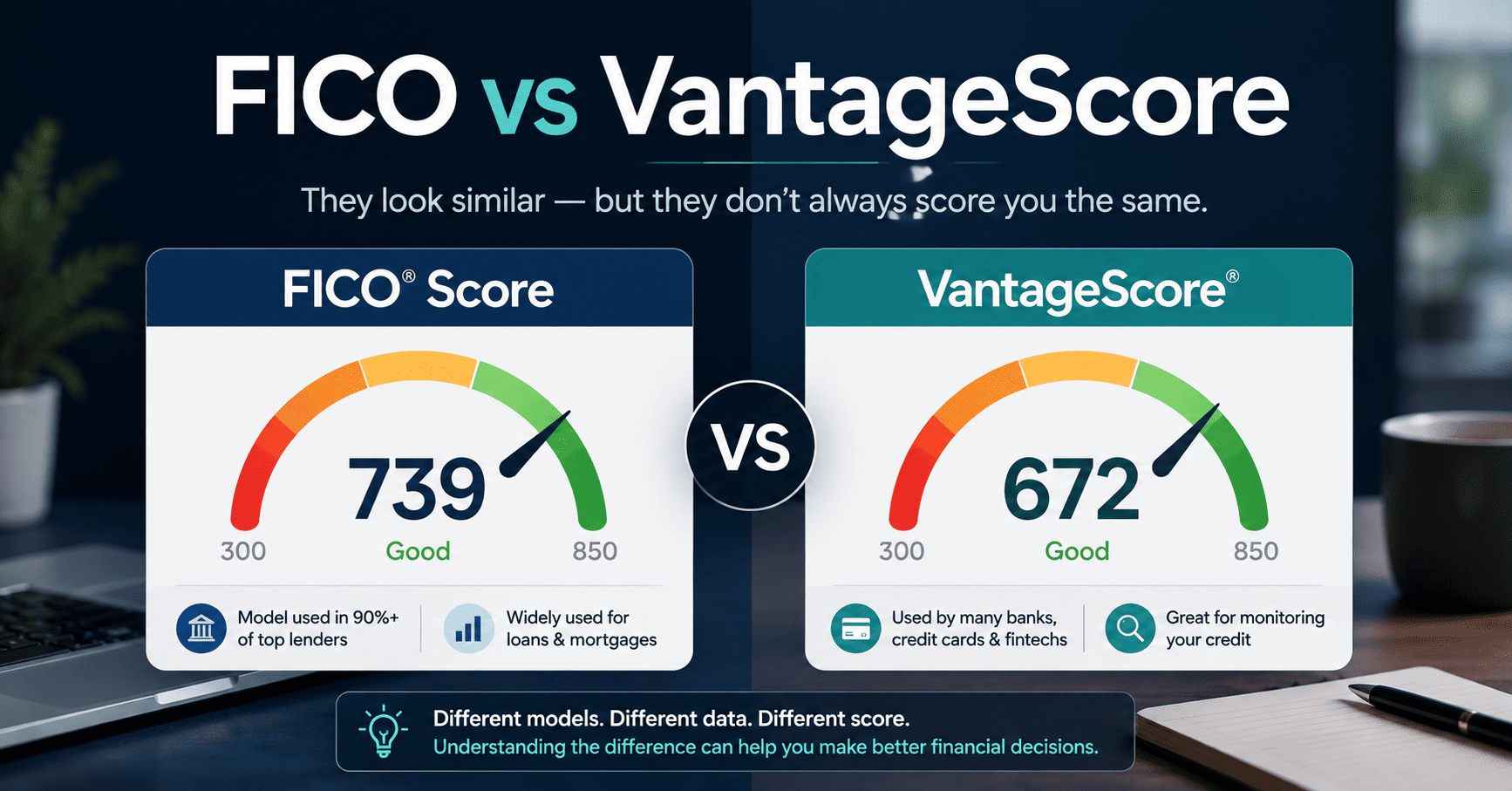
Two of the most important credit-scoring brands in the United States are FICO and VantageScore.
Both are designed to estimate credit risk. Both commonly use a 300-to-850 scoring range. And both analyze information contained in your credit reports.
But they are not the same scoring system, and your FICO Score and VantageScore can be different even when they’re calculated from similar credit information.
Here’s what you need to know.
FICO vs. VantageScore at a Glance
| Feature | FICO | VantageScore |
|---|---|---|
| Purpose | Estimate consumer credit risk | Estimate consumer credit risk |
| Common score range | 300–850 for base FICO Scores | 300–850 |
| Uses credit-report data | Yes | Yes |
| Multiple model versions | Yes | Yes |
| Used by lenders | Yes | Yes |
| Available from all 3 major bureaus | Yes | Yes |
| Can produce a different score from the other model | Yes | Yes |
| Payment history is highly important | Yes | Yes |
| Credit utilization matters | Yes | Yes |
| Commonly shown to consumers | Yes | Yes |
| Mortgage use | FICO remains important; multiple FICO models exist | VantageScore 4.0 can now be used by approved lenders for certain Fannie Mae/Freddie Mac loans |
The most important takeaway is simple:
FICO and VantageScore are two different ways of evaluating the information in your credit history.
A 700 FICO Score and a 700 VantageScore may look identical numerically, but they were not necessarily calculated in exactly the same way.
What Is a FICO Score?
A FICO Score is a credit-risk score developed by FICO, formerly known as Fair Isaac Corporation.
The first broadly used FICO credit score was introduced in 1989, and FICO Scores have since become deeply established in U.S. lending. FICO states that its scores are used by 90% of top U.S. lenders.
A base FICO Score generally ranges from:
300 to 850
Higher scores generally indicate lower credit risk.
But there’s an important detail:
There isn’t just one FICO Score.
FICO has developed multiple generations and versions of its scoring models.
Examples include:
- FICO Score 8
- FICO Score 9
- FICO Score 10
- FICO Score 10 T
- older “Classic FICO” models
- industry-specific FICO Scores
Some industry-specific FICO scores use a 250-to-900 range instead of the familiar 300-to-850 base-score range.
That means even two scores labeled “FICO” don’t necessarily have to be identical.
What Is VantageScore?
VantageScore is another credit-scoring system.
It was launched in 2006 as an independently managed joint venture of the three nationwide consumer reporting agencies:
- Equifax
- Experian
- TransUnion.
Like FICO, VantageScore uses information from consumer credit reports to estimate credit risk.
Modern VantageScore models commonly use the familiar:
300-to-850 range.
VantageScore has also released several generations of its model, including:
- VantageScore 3.0
- VantageScore 4.0
- VantageScore 4plus
- VantageScore 5.0.
As of 2026, VantageScore describes 4.0 as its most-used model in the marketplace, while VantageScore 5.0 is its newest model and is optimized particularly for unsecured and auto lending.
So just as there’s no single FICO model, there’s no single VantageScore model either.
The Biggest Difference Between FICO and VantageScore
At a high level, both systems are trying to answer essentially the same question:
How risky might it be to lend money to this consumer?
But they use different proprietary mathematical models to reach that conclusion.
Think of it like two teachers grading the same student.
Both teachers might consider:
- homework;
- exams;
- attendance;
- class participation.
But one teacher might give exams more weight, while another might place more weight on assignments.
The student is the same.
The underlying information is similar.
But the final grade can be different.
Credit scoring works in a comparable way.
Both FICO and VantageScore consider factors such as payment behavior, debt balances, utilization, account history, and recent credit activity.
But they don’t necessarily evaluate every piece of information in exactly the same way.
That is one major reason your scores can differ.
How Does FICO Calculate Your Score?
FICO traditionally organizes the information affecting a base FICO Score into five major categories.
For the general population, FICO lists their approximate importance as:
| FICO Factor | Approximate Weight |
| Payment history | 35% |
| Amounts owed | 30% |
| Length of credit history | 15% |
| New credit | 10% |
| Credit mix | 10% |
FICO notes that these percentages are general guidelines rather than fixed formulas for every individual. The importance of a particular factor can vary depending on the person’s overall credit profile.
Let’s briefly break them down.
Payment History
FICO wants to know whether you’ve paid credit obligations as agreed.
Late payments, collections and other serious delinquencies can negatively affect this area.
Amounts Owed
This includes the amount of debt you’re carrying and how much of your revolving credit limits you’re using.
Credit utilization is particularly relevant here.
Length of Credit History
Older established accounts can contribute positively to your overall credit profile.
New Credit
Opening multiple accounts or generating several hard inquiries in a short period can indicate greater risk.
Credit Mix
The model also considers your experience with different forms of credit, such as revolving accounts and installment loans.
For a deeper explanation of these factors, see our guide:
What Is a Credit Score and How Does It Actually Work?
How Does VantageScore Calculate Your Score?
VantageScore considers many of the same broad credit behaviors, but its models organize and evaluate them differently.
VantageScore identifies factors including:
- payment history;
- total credit usage;
- credit mix and experience;
- recently opened accounts;
- balances and available credit.
Its consumer guidance identifies payment history as one of the most influential factors, followed by credit usage and credit experience.
Different generations of VantageScore can also calculate these factors differently.
For example, VantageScore’s published methodology for VantageScore 3.0 lists:
| VantageScore 3.0 Factor | Weight |
| Payment history | 40% |
| Depth of credit | 21% |
| Credit utilization | 20% |
| Balances | 11% |
| Recent credit | 5% |
| Available credit | 3% |
However, you shouldn’t use these percentages to try to calculate your score manually.
Credit-scoring algorithms are considerably more complex than simply adding five percentages together.
Instead, use the categories to understand which behaviors generally matter.
Both Care About the Same Basic Habits
Despite their differences, you don’t need one financial strategy for FICO and another completely different strategy for VantageScore.
The basic habits that support strong credit tend to help your overall credit profile under both systems:
- make payments on time;
- keep revolving balances under control;
- avoid maxing out credit cards;
- apply for new credit selectively;
- maintain established accounts responsibly;
- review your credit reports for inaccuracies.
In other words:
Don’t try to “game” one particular scoring model.
Focus on building a healthy credit history.
Why Is My FICO Score Different From My VantageScore?
This is probably the most important question in this article.
Suppose your VantageScore is:
720
but your FICO Score is:
695
Nothing is necessarily wrong.
Several things could explain the difference.
1. Different Scoring Algorithms
FICO and VantageScore use different mathematical models.
Even when they analyze similar information, they may assign different significance to individual elements of your credit history.
One model might react differently to:
- a recent credit-card balance increase;
- an old late payment;
- a new account;
- a thin credit history;
- changes in utilization.
The exact impact depends on the rest of your credit profile.
2. Different Model Versions
You could be comparing:
FICO Score 8
with:
VantageScore 3.0
or:
FICO Score 9
with:
VantageScore 4.0
Those aren’t merely different companies.
They’re different generations of scoring technology.
Even your FICO Score 8 and FICO Score 9 can differ.
The same is true of VantageScore 3.0 and 4.0.
3. Different Credit Bureaus
A score is calculated using information from a credit report.
The major nationwide reporting agencies are:
- Experian;
- Equifax;
- TransUnion.
Your reports may not be perfectly identical.
For example, imagine one account appears on your Experian and TransUnion reports but has not yet been updated on Equifax.
A score based on Experian could therefore differ from one based on Equifax—even if both scores use the same scoring brand.
The Consumer Financial Protection Bureau specifically explains that your score can differ depending on the credit reporting agency supplying the information, the scoring model, the type of loan product, and even the date the score was calculated.
4. The Scores May Have Been Calculated on Different Dates
Credit information changes.
Suppose your credit card reports:
$4,500 balance
on Monday.
You pay it down to:
$500
on Tuesday.
But the card issuer doesn’t immediately report the lower balance to every bureau.
A score generated before the update may still reflect $4,500.
Another score generated after the updated balance reaches a bureau could reflect $500.
So sometimes the difference has less to do with FICO vs. VantageScore and more to do with timing.
5. The Lender May Use an Industry-Specific Score
The score displayed in a consumer app isn’t necessarily the same type of score that a lender uses.
FICO offers industry-specific scores for areas such as auto lending and credit cards, and these scores can use different ranges and model configurations from base FICO Scores.
This helps explain situations like:
“My app says 740, but the dealership says my score is 711.”
Both numbers might be legitimate.
They simply may not represent the same scoring model.
FICO vs. VantageScore: Which One Do Lenders Actually Use?
The answer is:
It depends on the lender and the type of credit you’re applying for.
FICO remains extremely important in consumer lending. FICO states that its scores are used by 90% of top U.S. lenders.
But it would now be inaccurate to dismiss VantageScore as merely an “educational score.”
VantageScore is also used by financial institutions, and its role has expanded significantly.
According to VantageScore, more than 3,700 institutions use its scores or related tools.
More importantly, the U.S. mortgage market has recently begun changing.
Important 2026 Update: VantageScore and Mortgages
For many years, mortgage lending tied to Fannie Mae and Freddie Mac depended heavily on older Classic FICO models.
That landscape is now changing.
As of April 22, 2026, the Federal Housing Finance Agency states that approved lenders may, during the current interim phase, choose between:
- Classic FICO, or
- VantageScore 4.0
for eligible loans sold to Fannie Mae and Freddie Mac.
FHFA has also approved FICO Score 10T for future use, although its broader implementation follows a separate timeline.
This is important because older advice online often says something like:
“VantageScore doesn’t matter for mortgages.”
That statement is now outdated.
VantageScore 4.0 has become part of the U.S. mortgage-scoring landscape, although implementation is still evolving and not every lender will necessarily use it for every mortgage.
Which Credit Score Does Credit Karma Show?
As of 2026, VantageScore’s official list of free-score providers states that Credit Karma provides VantageScore 3.0 scores based on TransUnion and Equifax data.
That distinction matters.
If Credit Karma shows:
735
you should not automatically assume that a lender will see a 735 FICO Score.
The 735 is still a real credit score.
It’s simply a score generated using a particular model and bureau.
This is one of the main reasons consumers sometimes become confused when they apply for financing.
What About Chase Credit Journey?
VantageScore’s current provider information states that Chase Credit Journey provides consumers a VantageScore 3.0 based on Experian data.
Again, that doesn’t make the score useless.
It can still help you monitor the overall direction of your credit.
But you should understand what score you’re looking at.
Is a VantageScore a “Fake” Credit Score?
No.
This is an important misconception.
A VantageScore is a legitimate credit-risk score used in the financial industry.
The confusion usually comes from the fact that a consumer may see a VantageScore through a free app while a particular lender uses a FICO model.
If the scores differ, the consumer may conclude:
“The free score was fake.”
That’s not the right way to think about it.
A better comparison is:
They’re different measuring systems.
The question isn’t whether the score is real.
The question is:
Which scoring model will the particular lender use for the particular financial product you’re applying for?
Does FICO Have Different Scores Too?
Yes—and this is one of the biggest sources of misunderstanding.
Many consumers think:
FICO = one score
and:
VantageScore = another score.
In reality, you can have many FICO Scores.
Different FICO generations and specialized models can generate different numbers.
For example, FICO lists different versions designed for general lending and industry-specific uses. Base FICO Scores typically range from 300 to 850, while certain industry-specific FICO Scores range from 250 to 900.
Therefore:
FICO vs. VantageScore isn’t a comparison of two individual numbers.
It’s a comparison of two families of scoring models.
What Is VantageScore 5.0?
There’s another development worth knowing about.
VantageScore introduced its 5.0 model in 2025 and announced its availability in 2026.
The model is designed particularly for unsecured lending—including credit cards, retail cards, and personal loans—as well as auto lending. VantageScore says the model uses newer attributes and was trained using post-pandemic consumer credit data.
However, this does not mean every lender or free credit app suddenly uses VantageScore 5.0.
Different institutions adopt scoring models at different speeds.
For example, many consumer services still provide VantageScore 3.0, while the newer mortgage transition specifically involves VantageScore 4.0.
This is another reason the exact model name matters.
FICO vs. VantageScore for People With Limited Credit History
One meaningful difference between scoring systems involves who can receive a score.
Traditional FICO scoring generally requires:
- at least one account that has been open for six months or longer; and
- at least one account reported to the credit bureau within the previous six months.
VantageScore has designed newer models to score a broader population, including some consumers with thinner or less conventional credit histories.
VantageScore says its 4.0 model can score millions of additional consumers who may not meet conventional scoring requirements.
This can matter for:
- young adults;
- new borrowers;
- people who haven’t used traditional credit recently;
- consumers with thin credit files.
It doesn’t necessarily mean that one score will always be higher than the other.
It means the models have different scoreability requirements and methodologies.
Does One Score React Faster Than the Other?
Possibly, depending on the specific model and change involved—but there is no universal rule that says:
“VantageScore always moves first”
or:
“FICO always moves slower.”
The effect of a change depends on:
- which model is used;
- which bureau’s data is used;
- when the creditor reported the information;
- what else is in your credit file.
For example, paying down a maxed-out credit card could improve your credit profile once the lower balance is reported.
But the exact point increase under FICO and VantageScore may not be identical.
That’s normal.
Example: Why Sarah Has Three Different Credit Scores
Suppose Sarah checks three sources.
Credit-monitoring app
VantageScore 3.0 based on TransUnion:
718
Credit card issuer
FICO Score 8 based on Experian:
704
Auto lender
Industry-specific FICO Score:
691
Sarah might think:
“My credit score dropped 27 points when I applied for the car.”
But that’s not necessarily what happened.
She may simply be comparing three different measurements.
The scores could have:
- different models;
- different credit bureaus;
- different calculation dates;
- different purposes.
The best way to compare credit-score changes is therefore:
Compare the same model, from the same bureau, over time.
For example:
VantageScore 3.0 TransUnion in January:
680
VantageScore 3.0 TransUnion in June:
715
That’s a much more meaningful comparison than comparing a 715 VantageScore with a 690 industry-specific FICO Score.
Which Score Should You Monitor?
For general credit health:
Monitoring either a legitimate FICO Score or VantageScore can be useful.
What matters is understanding what you’re monitoring.
If you simply want to know whether your credit profile is improving over time, a consistently provided VantageScore can still show useful trends.
But if you’re preparing for a specific lending decision, it becomes more important to understand what score that lender is likely to use.
For example:
Applying for a credit card?
The issuer may use a particular FICO or VantageScore model plus its own underwriting criteria.
Buying a car?
The lender may use an auto-specific scoring model.
Applying for a mortgage?
Ask the mortgage professional which scoring model and process applies, particularly because the U.S. mortgage scoring framework is undergoing a transition in 2026.
Instead of obsessing over one universal number, ask:
What score am I looking at, and is it relevant to the financial product I’m preparing for?
Which Is More Important: FICO or VantageScore?
There isn’t a single answer for every consumer.
FICO may deserve extra attention if:
- you’re preparing for a lender known to use FICO;
- you’re reviewing FICO Scores supplied by a bank or lender;
- you’re preparing for a credit product where a particular FICO version is used.
VantageScore deserves attention if:
- your lender uses VantageScore;
- you monitor your credit through a service that supplies VantageScore;
- you’re working with a lender participating in newer mortgage scoring options;
- you want to track general changes in your credit profile through a consistent VantageScore source.
The key is not:
FICO good, VantageScore bad
or:
VantageScore good, FICO outdated.
The practical answer is:
The score your lender actually uses matters most for that application.
How to Improve Both FICO and VantageScore
Fortunately, you don’t need to memorize every scoring algorithm.
Focus on the fundamentals.
1. Pay Every Account on Time
Payment history is highly important in both scoring systems.
Even one serious late payment can damage an otherwise healthy credit profile.
Set:
- automatic payments;
- calendar reminders;
- banking alerts.
At minimum, protect yourself from accidentally missing a due date.
2. Keep Credit Card Balances Under Control
Both scoring systems pay attention to revolving-credit usage.
A card with:
$4,800 balance
on a:
$5,000 limit
looks very different from a card with:
$300 balance
on that same limit.
If your utilization is high, paying revolving balances down may be one of the most actionable ways to improve your credit profile.
Read next:
What Is Credit Utilization and Why Does It Matter?
3. Don’t Apply for Credit You Don’t Need
New accounts and recent applications can affect your credit profile.
That doesn’t mean you should never apply for credit.
It means you shouldn’t repeatedly open accounts just to chase points.
Open credit when it serves a legitimate financial purpose.
4. Keep Older Accounts in Good Standing
The age and depth of your credit history can matter.
Before closing an old account, consider how that decision may affect your overall credit profile.
That doesn’t mean every account should remain open forever—especially if it has fees or other disadvantages.
Credit decisions should make financial sense first.
5. Review All Three Credit Reports
Your score depends on the information contained in your credit files.
If inaccurate information appears there, it can affect the scores calculated from that report.
Review your reports from:
- Equifax;
- Experian;
- TransUnion.
If you discover inaccurate information, use the appropriate dispute process rather than trying to manipulate the scoring model.
Should You Try to Get the Same FICO and VantageScore?
No.
There’s no reason your scores need to match.
For example:
FICO:
706
VantageScore:
721
doesn’t mean something needs to be fixed.
They’re different models.
Instead, focus on whether:
- you’re paying on time;
- balances are reasonable;
- your reports are accurate;
- negative information is aging;
- your overall credit profile is improving.
Strong fundamentals generally matter more than forcing two algorithms to produce the same number.
Frequently Asked Questions
Is FICO the same as a credit score?
FICO is a brand and family of credit-scoring models.
A FICO Score is a type of credit score, but not every credit score is a FICO Score.
VantageScore is another family of credit scores.
Is VantageScore the same as FICO?
No.
Both evaluate credit risk, but they’re separate scoring systems developed by different companies and can calculate different scores from similar credit-report information.
Why is my Credit Karma score different from my FICO Score?
One major reason is that Credit Karma currently provides VantageScore 3.0 scores rather than FICO Scores. It also uses credit information from TransUnion and Equifax.
Your lender may use a different model, a different credit bureau, or both.
Is Credit Karma wrong if my lender gives me a different score?
Not necessarily.
The two companies may simply be showing different scoring models.
Always identify:
- model;
- version;
- credit bureau;
- calculation date.
Which credit score do mortgage lenders use in 2026?
There isn’t one universal answer.
During the current FHFA transition, approved lenders delivering eligible loans to Fannie Mae and Freddie Mac may use either Classic FICO or VantageScore 4.0. FHFA has also approved FICO Score 10T for future use as implementation progresses.
Consumers preparing for a mortgage should ask their lender which scoring model applies to their specific application.
Does VantageScore matter anymore?
Yes.
VantageScore is used by financial institutions, appears in numerous consumer-credit services, and VantageScore 4.0 now has a direct role in parts of the mortgage market.
Is a 700 FICO Score equal to a 700 VantageScore?
Numerically, they’re both 700.
But they aren’t necessarily equivalent measurements.
Each score was produced by a different model, so the underlying risk interpretation and the factors that produced that score can differ.
Can my FICO Score be lower than my VantageScore?
Yes.
It can also be higher.
There is no rule requiring one system to consistently produce higher scores than the other.
Can I have more than one FICO Score?
Yes.
FICO offers multiple generations and industry-specific scoring models, so consumers can have numerous FICO Scores at the same time.
Can I have more than one VantageScore?
Yes.
Different VantageScore versions exist, and a score can also differ depending on whether the underlying data comes from Equifax, Experian, or TransUnion.
FICO vs. VantageScore: The Bottom Line
FICO and VantageScore are not competing versions of one universal credit score.
They’re two separate families of credit-scoring models.
Both try to predict credit risk.
Both commonly use information from your credit reports.
Both generally reward healthy credit behaviors such as:
- paying on time;
- keeping revolving debt under control;
- avoiding excessive new credit;
- maintaining a responsible credit history.
But they don’t calculate risk in exactly the same way.
That’s why you might see:
FICO Score: 698
and:
VantageScore: 721
at roughly the same time.
That doesn’t automatically mean one is wrong.
Before comparing any two scores, ask four questions:
- Which scoring model is this?
- Which version is it?
- Which credit bureau supplied the data?
- When was the score calculated?
Those four details explain many of the mysterious credit-score differences consumers encounter.
And if you’re preparing for a major financial application, there’s a fifth question:
Which score will my lender actually use?
That’s ultimately the number that matters most for that particular decision.
Instead of chasing every score shown on every app, build the kind of credit history that performs well across scoring systems.
Pay on time.
Keep balances manageable.
Review your reports.
Use new credit carefully.
And give positive credit behavior enough time to work.
That’s a much stronger strategy than trying to optimize your finances for a single number.
Editorial Sources
This article was prepared using current information from:
- Consumer Financial Protection Bureau (CFPB)
- Federal Housing Finance Agency (FHFA)
- FICO
- VantageScore
Credit-scoring models, lender requirements and mortgage-industry rules can change. Content should be periodically reviewed for accuracy.
Educational disclaimer: This content is provided for general educational purposes only and does not constitute individualized financial, credit, legal, lending, or mortgage advice.